SCHOOL LEAK DETECTION
Kitchen and catering area leak detection
Find concealed leaks around kitchens, catering equipment and supply pipes.
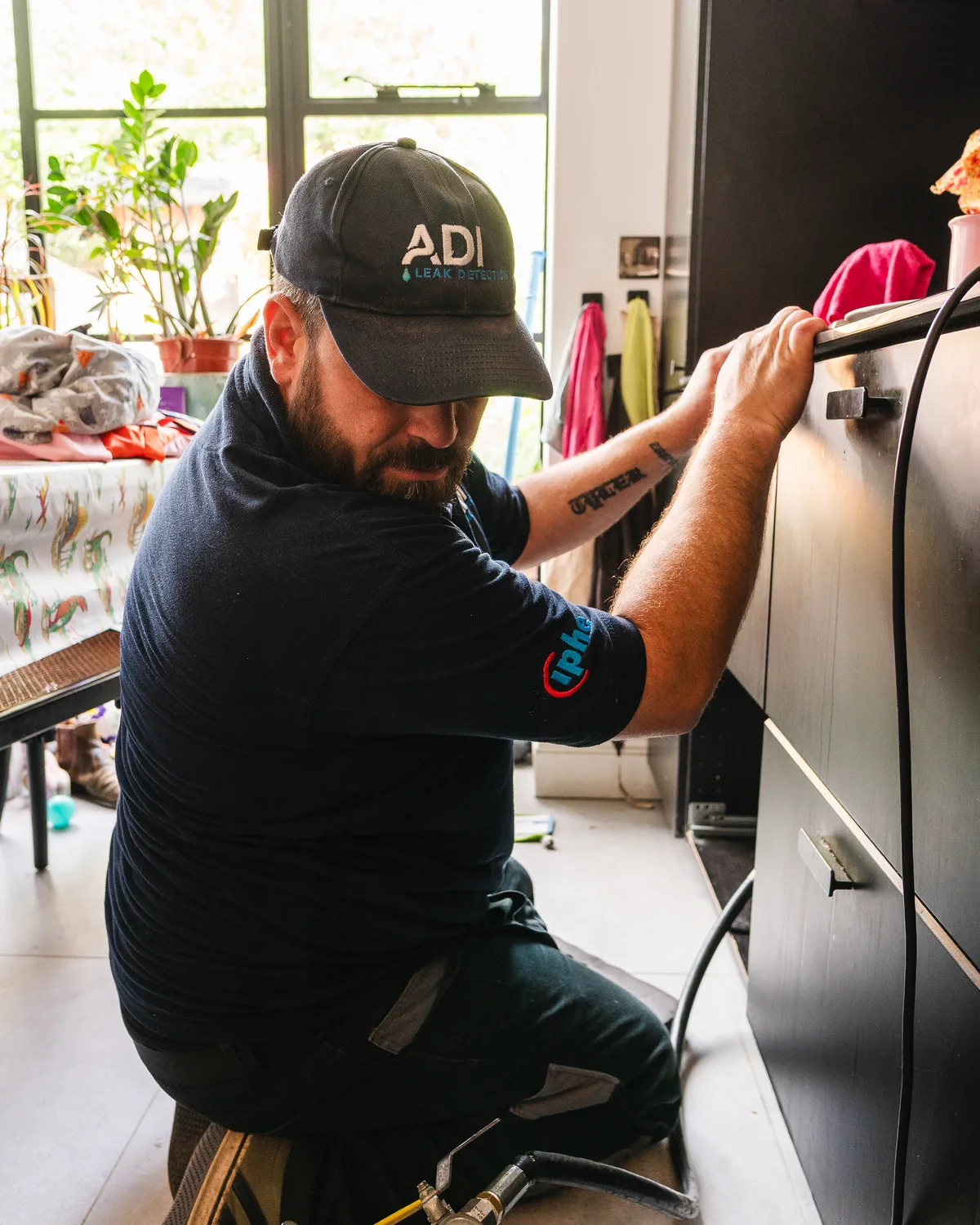
School kitchen leaks are usually a passing fill valve on fixed equipment, and the water tracks along the slab so it appears in a corridor rather than in the kitchen.
WHAT TO LOOK FOR
Leak symptoms and common faults
- Dishwasher or glasswasher fill valve passing continuously
- A machine that fills when idle, running quietly to drain
- Combi oven or steamer water connection weeping
- Persistent damp behind a unit that cannot easily be pulled out
- Buried supply under a kitchen slab
- Overnight flow that persists with every appliance isolated
- Failed water softener regeneration valve
- Continuous discharge to drain and a salt tank emptying fast
- Blocked or damaged floor gully mistaken for a supply leak
- Standing water only during service, never overnight
Check the equipment before you look at the pipework
Commercial catering equipment fails in a way that looks exactly like a pipe leak on a meter and nothing like one on the floor. A dishwasher fill valve that does not close fills the machine and runs to drain continuously, day and night, without producing a single wet patch.
- Take a meter reading with the kitchen closed and everything switched off at the isolator
- Repeat it in the morning. Movement means something on the incoming side is running
- Isolate appliances one at a time at their service valves and watch the meter stop
- Only when every appliance is eliminated does the search move to the pipework
Supplies under fixed equipment and under the slab
Kitchen supplies frequently run under the floor to appear at service points in the middle of the room, because that is the only sensible way to feed an island. When one of those buried runs fails, the water goes under the slab and follows the floor's fall.
That is why the damp shows in the servery or a corridor rather than in the kitchen. Locating from where the water appears is guaranteed to be wrong.
How a kitchen leak is located without stripping the room out
Once appliances are eliminated, the pipework section is isolated and pressure tested to confirm the loss and its rate. Tracer gas is then introduced into the drained section and surveyed at the floor surface, which locates a leak beneath fixed equipment without moving the equipment.
Where the run is hot, thermal imaging over the floor often finds it faster. Where the kitchen has an appliance no one can isolate, the pragmatic answer is to isolate the whole kitchen overnight and test the pipework only.
Hygiene, service times and getting access
A school kitchen is a food production environment with its own hygiene regime. Work during preparation and service is not realistic, and anything that opens a floor needs the kitchen out of use and properly cleaned afterwards before food production restarts.
The practical windows are after service, inset days and holidays. Detection work outside the kitchen, at the meter and on the incoming supply, can happen any time.
Arrange a school leak detection survey
School leak survey questions
Water appears in the corridor outside the kitchen. Is the leak there?
Probably not. Kitchen floors fall towards a gully and slabs let water track, so water surfaces at the lowest available point rather than above the defect. The corridor is where it emerged, not where it started.
How do we know if it is the dishwasher rather than a pipe?
Isolate it at its service valve overnight and read the meter before and after. If the meter stops moving, the machine is the leak. It is the cheapest test on the list and it eliminates the most common cause first.
Can the survey be done without closing the kitchen?
The meter and appliance elimination work can be done outside service hours without closing anything. A floor survey needs the kitchen quiet and the floor clear, which usually means after service or in a holiday.
Sources for this page
Last reviewed . How this site sources and dates its figures.