DETECTION METHOD
Tracer gas leak detection on school sites
Trace gas escaping from an isolated pipe when a water leak is difficult to hear.
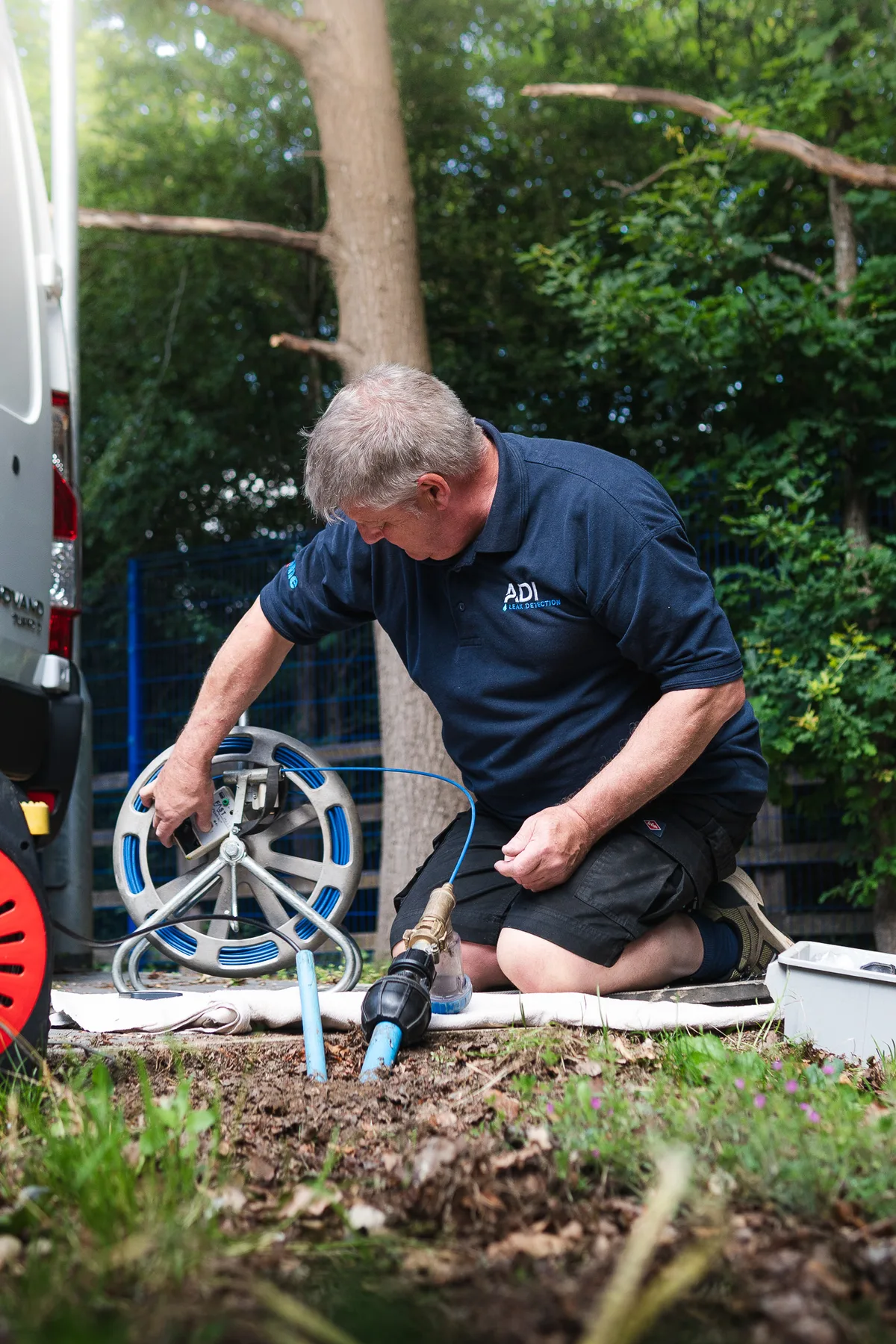
Tracer gas fills an isolated, drained pipe section and escapes through the leak, rising to the surface where a detector finds it regardless of pipe material.
- What it detects
- Leaks on any pipe material, including plastic, and under floors and hard surfaces
- Invasiveness
- Non-invasive, needs access to the pipe
- Works through
- Soil, sub-base, concrete, screed, tiling and plaster
- Constraint on a school site
- The section has to be isolated and drained, so it needs a window when that part of the site can be off supply
- When it is used
- The method used when acoustic work cannot resolve the position
What tracer gas detection actually does
The pipe section is isolated and drained, then charged with a hydrogen and nitrogen mixture. Hydrogen is the smallest molecule there is, so it finds the same opening the water was finding, and it is buoyant, so it rises through whatever is above the pipe until it reaches the surface.
A hydrogen-sensitive detector then sweeps the surface above the run. Where the gas emerges, the leak is below. On a screed floor or a playground, the position is marked without anything being opened first.
Tracer gas on a screed-buried heating circuit: the isolated section charged with hydrogen and nitrogen, the gas rising through the screed at the defect, and the detector locating it at floor level.
Why it works where listening does not
Acoustic methods depend on the pipe carrying sound. Tracer gas depends only on there being a hole, which is the definition of the problem. That makes it the answer for plastic pipe, for low-pressure systems, for very small leaks, and for anywhere the acoustic signal is lost in ground noise.
It is also the method that works under a floor. Hydrogen passes through screed and tiling and appears at the surface; leak noise does not travel usefully through a floor build-up.
What it means on a school site specifically
The practical constraint is isolation. The section being tested has to be off supply and drained, which on a school site means agreeing which building or branch can lose water for a couple of hours and when.
On safety: at 5 percent in nitrogen the mixture is below the flammable limit for hydrogen in air, and nitrogen is inert. It is not a fire risk at working concentration and it leaves no residue in the pipe. It does displace oxygen in a confined space, so plant rooms and chambers are ventilated and treated as they would be for any inert gas work.
What the survey needs from the school
- A window when the section can be isolated and drained, agreed in advance
- Access to the run at a point where gas can be introduced, usually a drain-off or a disconnected fitting
- The floor area above the run clear, if the leak is internal
- Ventilation to plant rooms and chambers where work is taking place
Questions schools ask
Is the gas safe around children?
The working mixture is 5 percent hydrogen in nitrogen, which is below the flammable limit and inert. It is not toxic and leaves no residue. The ordinary precaution is ventilation in confined spaces, because any inert gas displaces oxygen there, so plant rooms and chambers are managed accordingly.
Do you have to drain the pipe?
Yes, for the section being tested. The gas has to occupy the pipe to reach the leak. That is why the survey is scheduled around a window when that branch can be off supply, and why the isolation valves being functional matters.
Will it work under a concrete floor?
Yes. Hydrogen passes through concrete, screed, tiling and floor coverings and emerges at the surface. That is the specific case where tracer gas is far better than any listening method.
Sources for this page
Last reviewed . How this site sources and dates its figures.