DETECTION METHOD
Thermal imaging for leaks in school buildings
Reveal temperature patterns that help trace heating pipes and investigate damp.
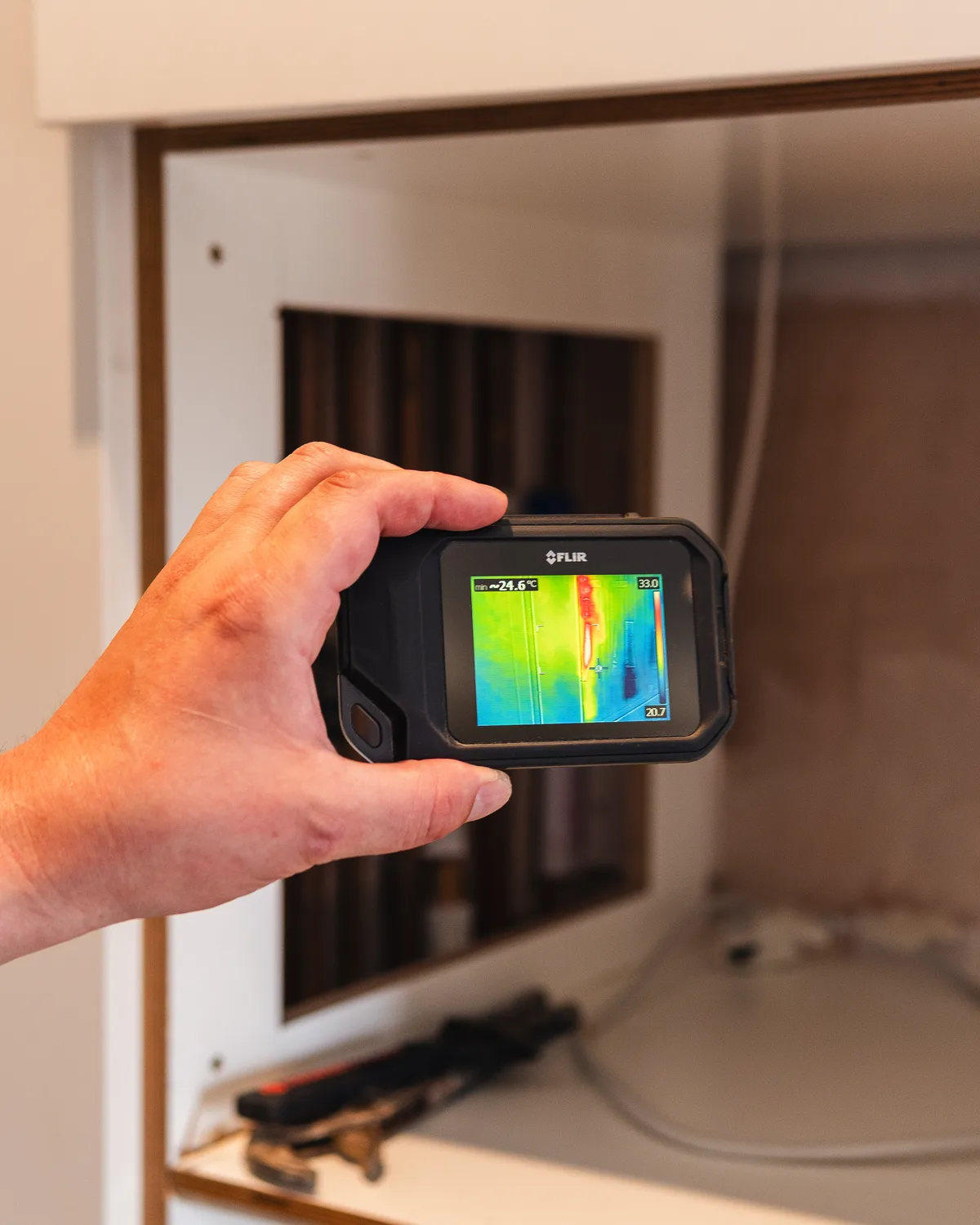
A thermal camera sees surface temperature, so it finds a heating leak as a warm plume and wet insulation as a thermal mass difference, never the water itself.
- What it detects
- Heating leaks under floors, wet insulation, and damp spreading through fabric
- Invasiveness
- Non-invasive
- Works through
- Nothing. It reads the surface only, and infers what is beneath it
- Constraint on a school site
- Rooms need to be clear of furniture on the area being scanned, and the heating usually needs to be running
- When it is used
- First look at an underfloor heating leak or a flat roof
What a thermal camera actually sees
A thermal camera measures the infrared radiating from a surface and renders it as temperature. It does not see through anything. What it detects is the effect of what is beneath: a warm pipe warms the floor above it, a leak on that pipe warms a wider area, and wet insulation holds and releases heat differently from dry insulation.
That makes it excellent at showing extent and pattern, and poor at confirming a point. It is the method that tells you where to look, and rarely the one that gives you the final answer on its own.
Where it works, and where it will mislead you
- Works: an underfloor heating leak, which appears as a diffuse warm area rather than the neat line of the pipe run
- Works: wet insulation in a flat roof, surveyed as the roof cools in the evening and the wet areas hold heat longer
- Works: mapping the extent of damp in a wall or ceiling, which is often larger than the stain
- Misleads: a cold water leak with no temperature difference, which produces no image
- Misleads: solar gain, underfloor voids, draughts and thermal bridging, all of which produce patterns that look like defects
What it means on a school building specifically
The best result on a school underfloor heating system comes from a cold morning with the heating on and the room empty, which in practice means an early start before the first lesson. Furniture on the floor blocks the view, so the area being scanned needs clearing.
On a flat roof the useful window is the evening, as the roof cools. A survey at midday in June shows solar gain and almost nothing else.
What the survey needs from the school
- Heating running and up to temperature for an internal survey
- The floor area clear of furniture, mats and equipment
- An early or late slot rather than the middle of the day
- Roof access arranged in advance for an external survey, with the area below managed
Questions schools ask
Can a thermal camera find a cold water leak?
Only if there is a temperature difference to see. Cold water arriving into a warm floor void can produce a cool anomaly, but often there is nothing to image. For a cold water leak, tracer gas or acoustic methods are the reliable route.
Can you survey while the class is in the room?
Not usefully. Bodies are the warmest thing in a classroom and will dominate the image, and the floor needs to be clear. An empty room before school is the practical slot.
The image shows a warm patch. Is that definitely the leak?
It is where to look. Thermal imaging shows an effect, and several things produce similar effects, so the position should be confirmed with tracer gas or a pressure test before a floor is opened.
Sources for this page
Last reviewed . How this site sources and dates its figures.