SCHOOL LEAK DETECTION
Underground water main leak detection on school sites
Find hidden water loss beneath playgrounds, paths and playing fields.
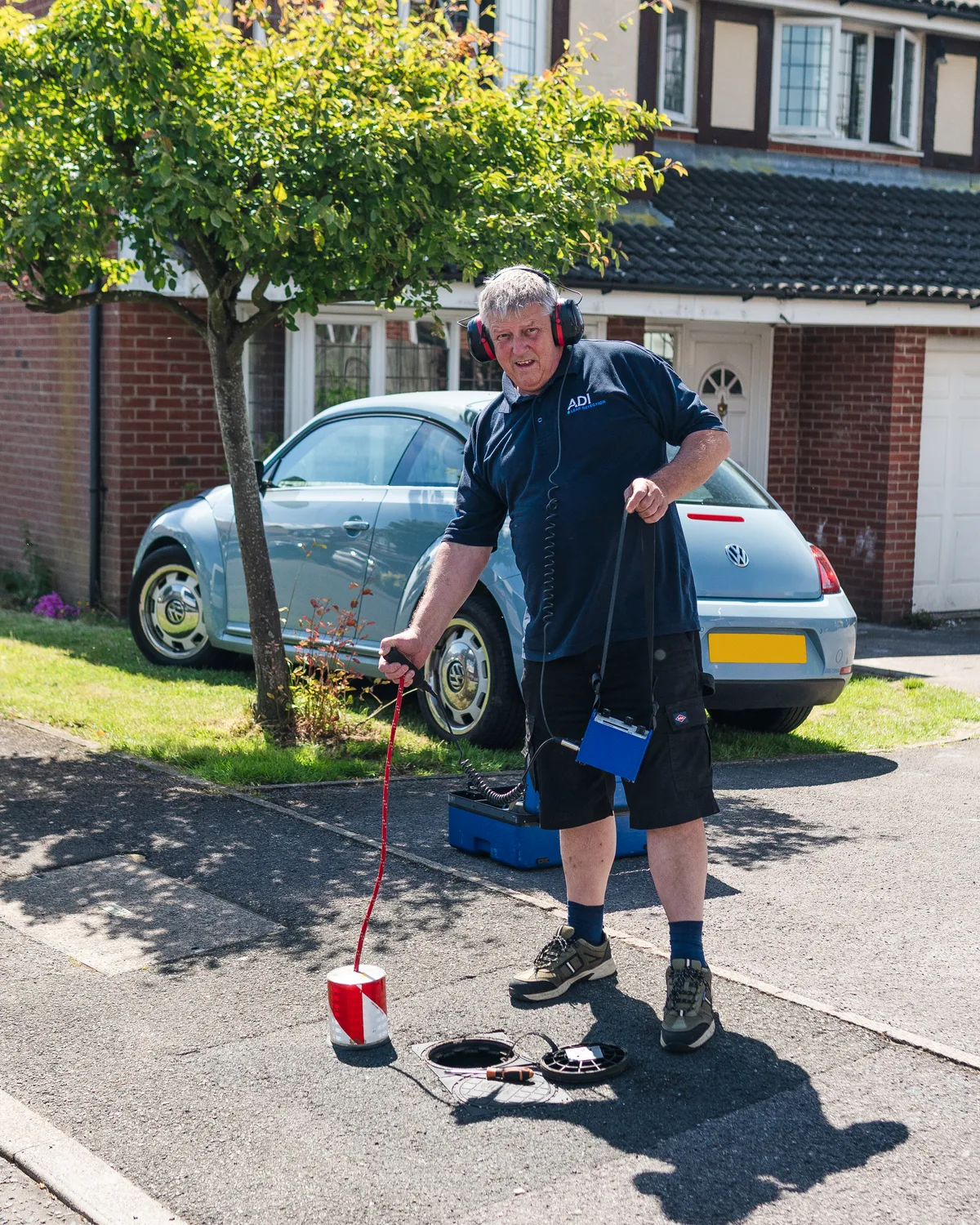
A buried school main usually leaks into free-draining ground and never surfaces, so the meter is the only symptom and the position is fixed acoustically from above.
WHAT TO LOOK FOR
Leak symptoms and common faults
- Joint failure on an old cast iron or steel main
- A sudden step change in daily consumption, with no visible water
- Perforation of MDPE by a stone in the bedding
- A slow, steady rise in the overnight minimum over months
- Damage from later works, typically a fence post, a resurfacing job or a new building
- A loss that starts in the same term the works happened
- Ground movement on clay soils or made ground pulling a joint
- Seasonal loss that worsens through a dry summer
- Lead or galvanised sections corroding through
- Discoloured water at the nearest outlet alongside the loss
Where the buried main sits on a school site
Water arrives at the boundary, passes the stop tap and the meter, and from there everything is the school's. On a primary that is one run to a plant room. On a secondary or a college it is a network: a spine to the main building and branches to every block, pavilion, kitchen and pitch.
The run is almost never where the drawing says. Playgrounds get resurfaced, car parks get extended, temporary classrooms arrive and leave, and the pipe stays where it was laid. Locating it electronically before excavating is not a refinement; it is what prevents a trench in the wrong place.
Section through a buried school water main showing the boundary stop tap, the meter chamber, the bedding, and how a leak below a free-draining sub-base disperses without ever reaching the surface.
How a school main fails, and what the meter shows
There are two shapes of failure and they behave differently on the bill. A joint that lets go produces a step: consumption was one figure, now it is another, and the change happened on a date. A perforation produces a ramp: consumption creeps up over months and nobody notices because each bill is only slightly worse than the last.
Neither necessarily produces water at the surface. Under a playground with a free-draining sub-base, water can leave a 15mm hole all year and go straight down.
How the position is found without trenching the run
- Measure the loss at the incoming meter overnight, so you know the size of what you are looking for before you start
- Isolate section by section at the valves and watch which closure removes the flow, reducing the site to one branch
- Trace the branch electronically to establish where the pipe actually runs and how deep it is
- Correlate along the run with acoustic loggers, or charge the isolated section with tracer gas where the pipe is plastic or the ground damps the sound
- Mark the position on the surface and confirm it before anything is opened
Plastic pipe is the case where acoustic methods struggle: MDPE transmits leak noise poorly and made ground absorbs what does travel. That is precisely when tracer gas earns its place, because the gas rises through the ground to the surface regardless of what the pipe is made of.
What happens on the day of a survey
Most of the day is spent at the meter, at the valves and outside. The engineer needs the meter chamber open, access to the stop tap, and someone who knows which valve does what. If nobody knows, that is normal and it is part of the job to find out.
The output should be a position marked on the ground, a measured loss in litres per minute, a plan showing the route, and a report a school can send to a funder or an insurer.
Repair, reinstatement and the decision to reline or replace
A single point failure on a sound pipe is a repair. A pipe that has failed twice in three years is a replacement, and the honest advice is usually to renew the run rather than repair it again, because the second failure predicts a third.
Reinstatement is the cost people underestimate. Digging through tarmac in a playground means reinstating a play surface to a standard a school can let children onto, which is a different job from filling a hole in a car park.
Arrange a school leak detection survey
School leak survey questions
Is a leak on our side of the meter our responsibility?
Almost always, yes. The water company's responsibility typically ends at the boundary stop tap, and the supply pipe from there onto the site belongs to the property owner. That is why a school can be billed for water it never used and has no automatic right to have the pipe repaired for it.
Can we get the water charges reduced?
Sometimes. Wholesalers operate leakage allowance schemes for non-household customers, but the rules, the evidence required and the deadlines vary by wholesaler and change. Ask your retailer what scheme applies before you repair, because most schemes require the leak to be repaired within a set period and to be evidenced.
How deep will you have to dig?
Only at the located point, and only as deep as the pipe. A supply pipe is normally laid around 750mm deep, though on school sites it is frequently shallower where later ground level changes have taken cover away from it.
Sources for this page
- Source: The National Archives, The Water Supply (Water Fittings) Regulations 1999 (opens in a new tab) ().
- Source: MOSL, MOSL, the market operator for the non-household water retail market in England (opens in a new tab) ().
Last reviewed . How this site sources and dates its figures.