DETECTION METHOD
Acoustic leak location on school sites
Listen for the sound of escaping water and narrow down its position.
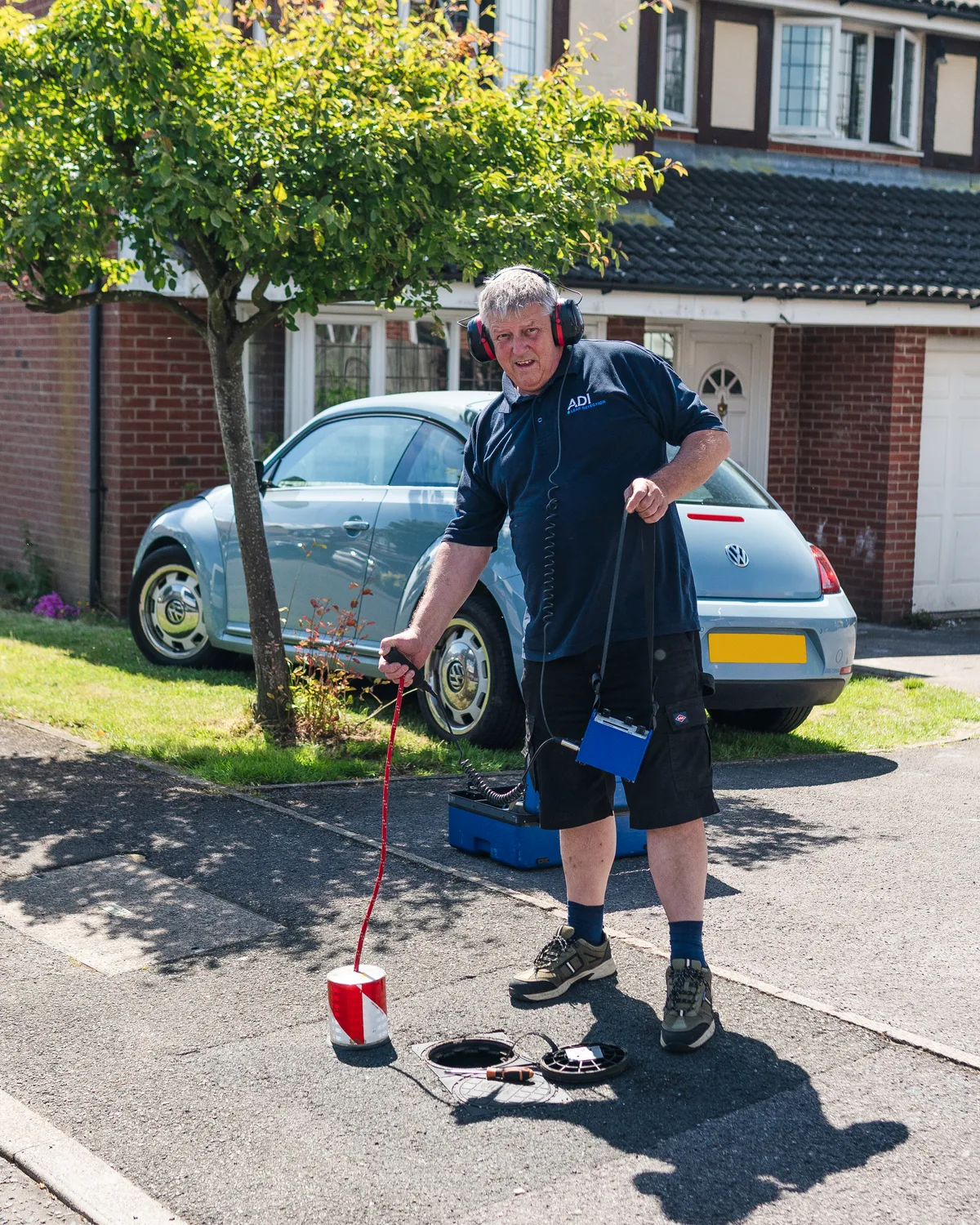
Acoustic location listens for the noise a pressurised leak makes and uses two sensors to time the difference, fixing the position along a buried run.
- What it detects
- Pressurised water leaks on buried and concealed pipework
- Invasiveness
- Non-invasive
- Works through
- Soil, tarmac, concrete, screed and building fabric
- Constraint on a school site
- Needs a quiet site, so it works best out of hours or in a holiday rather than at break time
- When it is used
- The first method tried on a buried supply or distribution main
What acoustic location actually does
Water escaping under pressure through a small opening makes a sound. That sound travels along the pipe wall and through the ground, and it is continuous, which distinguishes it from almost every other noise on a site.
Two techniques use it. Ground microphones listen at the surface and find where the sound is loudest, which is approximately above the leak. Correlation places a sensor at two contact points on the pipe, measures the tiny difference in arrival time of the same noise, and calculates the position between them. Correlation is the accurate one.
Acoustic correlation on a school distribution main: sensors at two valve chambers, the leak noise arriving at each at different times, and the calculated position marked on the surface between them.
What it finds, and what it cannot
- Finds: pressurised leaks on metal pipe, at useful distances, with good positional accuracy
- Finds: leaks under hard surfaces, because the sound travels through tarmac and concrete
- Struggles: plastic pipe, which damps the signal within a much shorter distance
- Struggles: very low pressure systems, where the leak makes little noise
- Cannot find: gravity drainage defects, which are not pressurised and therefore silent
- Cannot find: a leak on a section that cannot be pressurised or contacted at two points
What it means on a school site specifically
Two features of school sites work in favour of acoustic methods. There is usually a genuine quiet period, at night or in a holiday, when background noise is low. And there are usually accessible contact points: a boundary stop tap, a meter chamber, valve chambers between blocks and, on larger sites, hydrants.
One feature works against them. Modern school pipework is plastic, and where a school has renewed part of its network the acoustic signal stops at the material change. That is the moment the survey switches to tracer gas rather than continuing to listen.
What the survey needs from the school
- The meter chamber and boundary stop tap accessible and not under a parked car
- Valve chambers located and, ideally, exercised beforehand so they will actually close
- A quiet window, which on most sites means before 8am, after 5pm or a holiday
- Someone who knows the site, even if they do not know the pipework
Questions schools ask
Does the school have to be closed?
No, but a quiet site gives a cleaner result. Plant, traffic and playground noise all raise the background against which the leak noise has to be heard. An early start before the school fills is usually enough.
Our pipes are plastic. Will this work?
Less well, and sometimes not at all. Plastic absorbs leak noise, which shortens the distance over which correlation works. On a plastic run the survey normally moves to tracer gas, which does not care what the pipe is made of.
How accurate is it?
On a metal pipe with good contact at two points, correlation typically places a leak within about half a metre, which is close enough to open a single small excavation rather than a trench.
Sources for this page
Last reviewed . How this site sources and dates its figures.