SCHOOL LEAK DETECTION
Boarding house and residential accommodation leaks
Investigate leaks in occupied accommodation and shared water supplies.
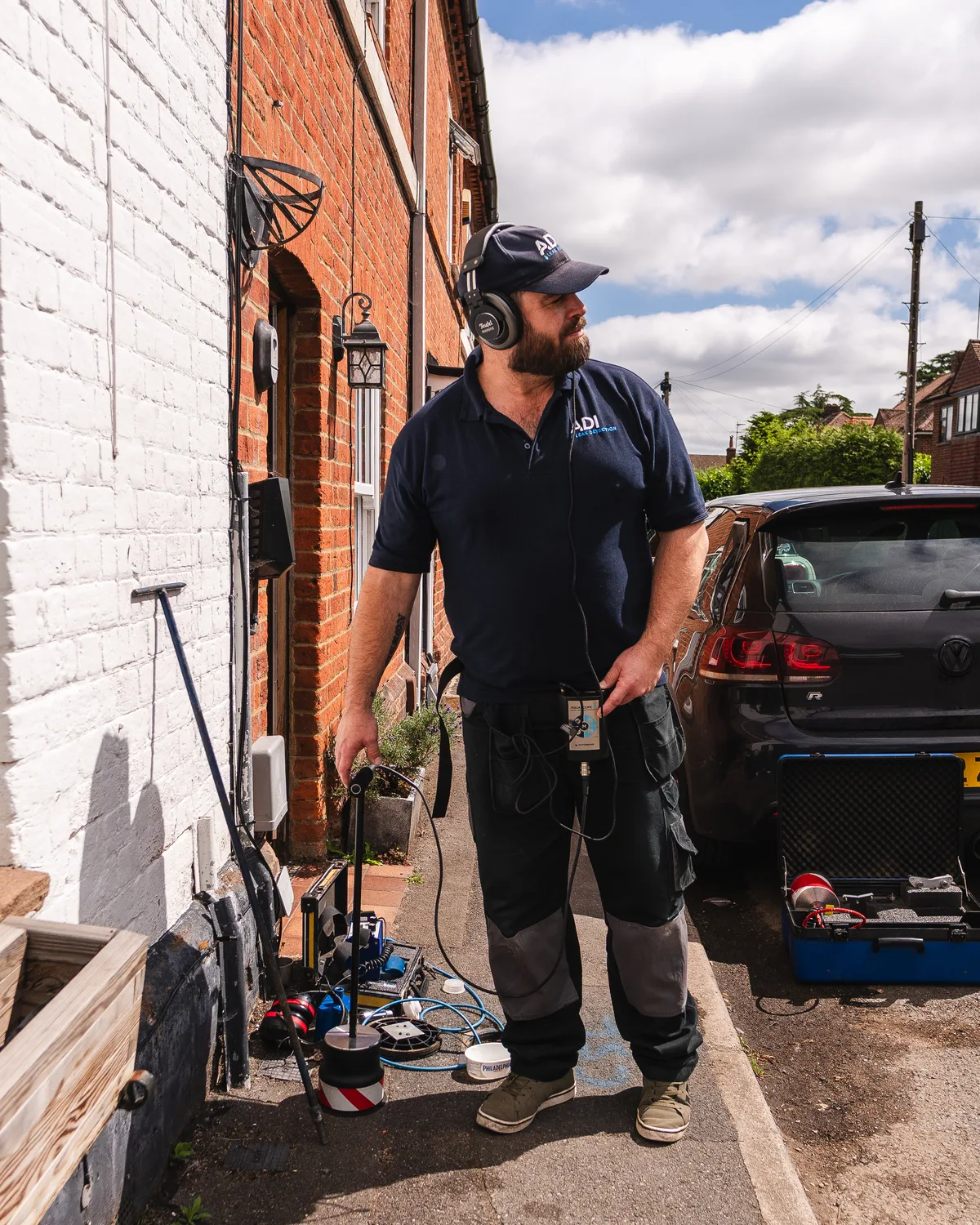
Boarding houses lose water through secondary hot water circuits and repeated bathroom refits, and the loss hides inside genuine residential use rather than showing as overnight flow.
WHAT TO LOOK FOR
Leak symptoms and common faults
- Secondary hot water return circuit leaking in a ceiling void
- A warm ceiling and a hot water system that never quite keeps up
- Shower valve or mixer passing continuously
- A shower that drips permanently, multiplied across a house
- Cistern float valve passing to overflow
- A permanent trickle at an external overflow pipe
- Concealed pipework damaged during a bathroom refit
- Staining on the ceiling below a recently refurbished bathroom
- Buried supply to a detached house or lodge
- Overnight flow that persists when the house is isolated internally
Why a boarding house is harder to test than a classroom block
A teaching block should use nothing at 3am. A boarding house legitimately uses water at 3am, because people live in it. That removes the clean zero baseline that makes school leak detection quick.
What replaces it is trend. Log the overnight minimum every night for a week. Genuine residential use varies night to night; a leak does not. The floor under the noise is the leak.
Secondary hot water circuits, the characteristic boarding fault
Boarding houses run secondary hot water circulation so that a tap runs hot without a long wait. That means a continuously circulating loop through ceiling voids and risers, usually installed decades ago and modified at every refurbishment.
A leak on a secondary return is expensive twice over, because the water is hot, and it is easy to miss because a warm damp ceiling in a boarding house gets blamed on the bathroom above it.
How the loss is located in an occupied house
- Log overnight minimum flow at the house meter or sub-meter for a week to establish the residual
- Isolate the house internally during the quiet window to separate a supply leak from an internal one
- Work down the house floor by floor where isolation valves allow, narrowing to a riser
- Use thermal imaging on the secondary circuit route and tracer gas on isolated sections to fix the position
Work in an occupied house is scheduled with the houseparent, not just with the estates office. An engineer moving through a boarding house at night needs a named person expecting them.
Getting the work done around residents
Detection can be done in term. Repairs that open a ceiling or take a bathroom out of use generally cannot, unless the house has spare capacity to move pupils. Exeat weekends and half terms are the realistic windows for anything invasive.
Where the house is a listed building, which is common in older independent schools, the survey method matters more than the repair method: locate without opening, then agree a single opening with the estates team.
Arrange a school leak detection survey
School leak survey questions
Our boarding house always shows overnight flow. How do we know if it is a leak?
Compare nights. Real residential use varies: some nights are higher, some lower. A leak is the constant floor beneath that variation. A week of overnight minimum readings separates the two without any equipment beyond the meter.
Can you work in the house while boarders are asleep?
Only with the school's agreement, an agreed route and a member of staff awake and expecting the engineer. Most of the measurement work happens at the meter and in plant spaces rather than in the accommodation itself.
A ceiling is staining below a bathroom we refurbished last year. Is that the refit?
It is the first thing to check, and it frequently is: a joint disturbed during the works, or a shower tray seal rather than the pipework. Moisture mapping the ceiling establishes the extent, and a pressure test of the branch tells you whether the pipework is sound before anyone opens it.
Sources for this page
- Source: Department for Education, Get Information About Schools: all establishment data extract (opens in a new tab) ().
- Source: Health and Safety Executive, HSG274 Part 2: The control of legionella bacteria in hot and cold water systems (opens in a new tab) ().
Last reviewed . How this site sources and dates its figures.