SCHOOL LEAK DETECTION
Roof and flat roof leak detection in schools
Investigate water entering the building and trace it back towards the source.
Water entering a school roof travels along the deck before it drops, so the ceiling stain is rarely under the defect that caused it.
WHAT TO LOOK FOR
Leak symptoms and common faults
- Failed lap or seam on a felt or single-ply flat roof
- Staining that appears within hours of heavy rain and dries between events
- Blocked or undersized rainwater outlet causing ponding
- Standing water visible on the roof days after rain
- Failed flashing at an upstand, parapet or rooflight
- Damp at the head of a wall rather than mid-ceiling
- Cracked or displaced tiles and slates on a pitched roof
- Localised staining that follows a rafter line
- Condensation mistaken for a roof leak
- Damp that is worst in cold weather and unrelated to rainfall
Why the stain does not tell you where the roof failed
Water gets through the waterproof layer at one point and then travels. On a flat roof it runs along the fall of the deck or between layers of the build-up. On a pitched roof it runs down a rafter or a felt lap. Only when it reaches a hole in the ceiling does it appear, and that hole is wherever a light fitting, a service penetration or a board joint happens to be.
The consequence for a school is expensive: patching above the stain fixes nothing, and the same classroom leaks again at the next storm.
Ruling out condensation before spending money on the roof
Schools generate a great deal of moisture: thirty people in a room, wet coats, poor ventilation in winter because opening windows makes the room cold. Interstitial condensation in a cold-deck flat roof produces damp ceilings that look exactly like a leak.
The distinguishing test is timing. A leak follows rainfall. Condensation follows cold weather and occupancy, and is usually worst on Monday mornings after a closed weekend.
How a roof entry point is traced
- Internal moisture mapping to establish the true extent of wetting rather than the extent of staining
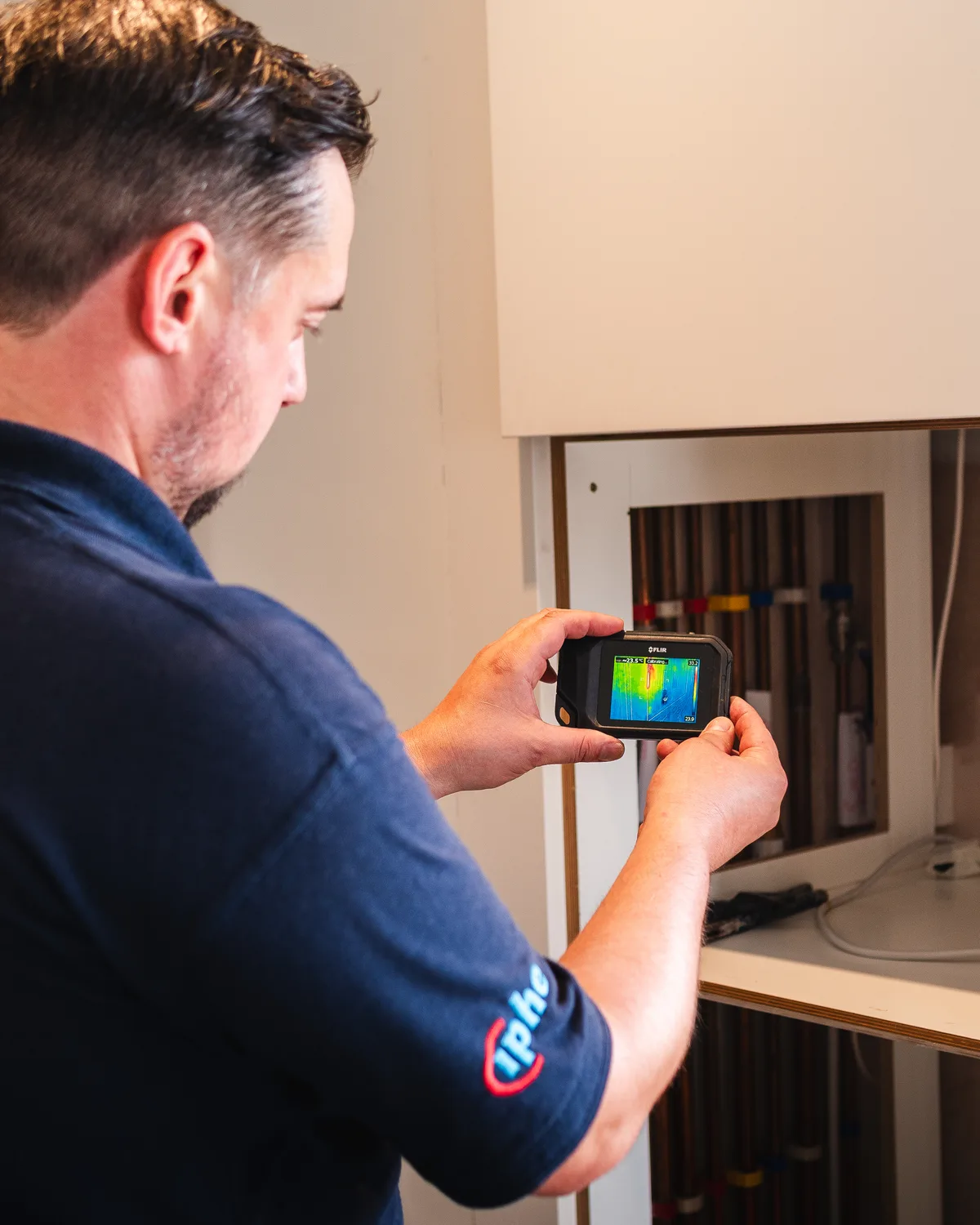
- Thermal survey of the roof deck, which shows wet insulation as a thermal mass difference and maps the spread rather than the point
- Water testing in controlled sections, working uphill from the suspected entry so each section is eliminated before the next
- Inspection of every penetration, upstand, outlet and joint, which is where the great majority of flat roof failures actually are
On a school roof the survey has to account for what else is up there. Plant, cable trays, safety line anchors and aerials are all penetrations, and each one is a candidate.
Access, safety and working above an occupied school
Roof work over an occupied school is a work at height job with a public below. Expect the school to want the area beneath cordoned, the access route agreed, and the work scheduled outside break and lunch.
Many post-war school roofs also contain asbestos in the build-up or in rooflight surrounds. Nothing should be cut, drilled or lifted before the asbestos register has been checked.
Arrange a school leak detection survey
School leak survey questions
The same classroom has leaked three times after being repaired. Why?
Because the repair was made above the stain rather than at the entry point. Water travels along the deck before it drops, so patching the ceiling side of the problem leaves the defect intact. Tracing the entry point is what breaks the cycle.
Is a roof leak a leak detection job or a roofing job?
Finding it is a detection job, fixing it is a roofing job, and the two are worth separating. A roofer asked to find and fix has an incentive to recommend a larger repair; an independent trace tells you exactly what needs doing before you buy it.
Could it be condensation rather than a leak?
Often, in a school. Condensation damp tracks cold weather and occupancy rather than rainfall, and it is usually more diffuse than a leak stain. If the damp appears on cold dry mornings and not during rain, treat ventilation before treating the roof.
Sources for this page
Last reviewed . How this site sources and dates its figures.